

How to Prepare for a Natural Birth (Without Fear or Guessing)
Most first-time parents don't feel unprepared because they didn't try.
They read the articles.
They watch the birth videos.
They take the hospital tour.
They make a birth plan.
And still… as the due date gets closer, the same thoughts creep in:
What if I can't handle labor?
How will I know what to do?
What if something changes?
Will my partner actually know how to help me?
If you've been searching for how to prepare for a natural birth but still feel unsure what you're supposed to do when labor actually begins, here's what I want you to know:
More information isn't always the answer.
You need preparation.
Because knowing what oxytocin is?
That's information.
Knowing how to relax your body when a contraction gets stronger?
That's preparation.
Reading about birth positions?
Information.
Having a partner who knows when and how to help you change positions?
Preparation.
Writing down your preferences?
Information.
Knowing how to ask questions when someone recommends something you weren't expecting?
Preparation.
And that's the difference I want to help you build.
Natural Birth Preparation Is More Than a Checklist
A lot of birth preparation looks like this:
✔ Pack the hospital bag.
✔ Choose the stroller.
✔ Take the tour.
✔ Write the birth plan.
Those things can be useful.
But none of them teach you what to do when you're three contractions into labor and suddenly thinking:
Ohhhh. This is REAL.
Natural birth preparation should help you build skills you can actually use when labor becomes intense.
That includes preparing:
your body
your mind
your coping skills
your partner
your ability to make decisions if something changes
Because birth is unpredictable.
Preparation doesn't have to be.
1. Prepare Your Body for Birth
Your body is going through an incredible amount of work during pregnancy—and staying active can help you maintain strength, mobility, and overall fitness as you prepare for birth.
During my pregnancies, I stayed active all the way up to labor.
I still remember hiking late in my third pregnancy and having strangers stop to ask whether I was okay because I looked very pregnant. 😄

What they couldn't see?
I felt strong.
Capable.
And connected to my body.
The next morning, labor began.
Now, did that hike cause labor?
No.
And being active doesn't guarantee an easy or unmedicated birth.
That's not the point.
The point is that pregnancy is a great time to support the body you'll be asking to do the work of labor.
Depending on your pregnancy and your provider's recommendations, that may include activities such as:
walking
swimming
prenatal yoga
appropriate strength work
gentle, consistent movement
The goal isn't to become a pregnancy fitness influencer.
It's to help your body feel supported, strong, and mobile.
And that is very different from doing random exercises because someone on Instagram promised they'd make your baby “slide right out.”
2. Nourish the Body Doing All This Work
You've probably heard the advice:
“Eat healthy.”
Helpful? Sure.
Specific? Not exactly.

Pregnancy places increased demands on your body, and good nutrition helps support your health as well as your baby's growth and development.
It can also help you build habits around nourishment and hydration that you'll continue relying on as pregnancy progresses.
One of our students, Amanda, came into pregnancy particularly aware of her health because preeclampsia ran in her family.
She couldn't control every outcome.
None of us can.
But she decided to focus on the things she could control:
nourishing herself consistently
staying hydrated
moving her body appropriately
staying engaged in her prenatal care
She ultimately made it to the end of her pregnancy healthy and without developing preeclampsia.
Her story isn't proof that food or exercise can prevent every complication.
It's a reminder that preparation is about working with what you can control—without pretending you can control everything.
That distinction matters.
A lot.
3. Prepare Your Mind Before Labor Tests It

Here's the part many first-time parents underestimate:
What happens in your mind when labor gets intense.
You can know exactly how a uterus contracts and still have a moment where your brain screams:
I cannot do this.
That's why mental preparation isn't about pretending birth won't be hard.
And it isn't about covering your bathroom mirror in affirmations you don't actually believe.
It's about learning how to notice fear without letting fear take over the whole room.
During my pregnancies, I kept a journal where I wrote letters to each of my babies.
It helped ground me.
When fear showed up, I could reconnect with something bigger than the fear I was feeling in that moment.
Your tools may look different.
You might practice:
breathing
visualization
prayer
journaling
meditation
birth affirmations
mentally rehearsing how you'll respond when labor becomes challenging
The goal isn't:
“I will never feel afraid.”
The goal is:
“When fear comes, I know how to come back to myself.”
That's a skill.
And skills can be practiced before labor.
If faith is an important part of how you prepare, you can also download our 7 Birth Affirmations with Scripture eBook to use throughout pregnancy and birth.
4. Practice Relaxation Before You Need It
Relaxation sounds simple.
Until you're having a contraction.
Then suddenly someone saying, “Just relax!” may make you want to throw a pillow at them.
That's why relaxation needs to become something you practice, not just something you hope you'll remember.
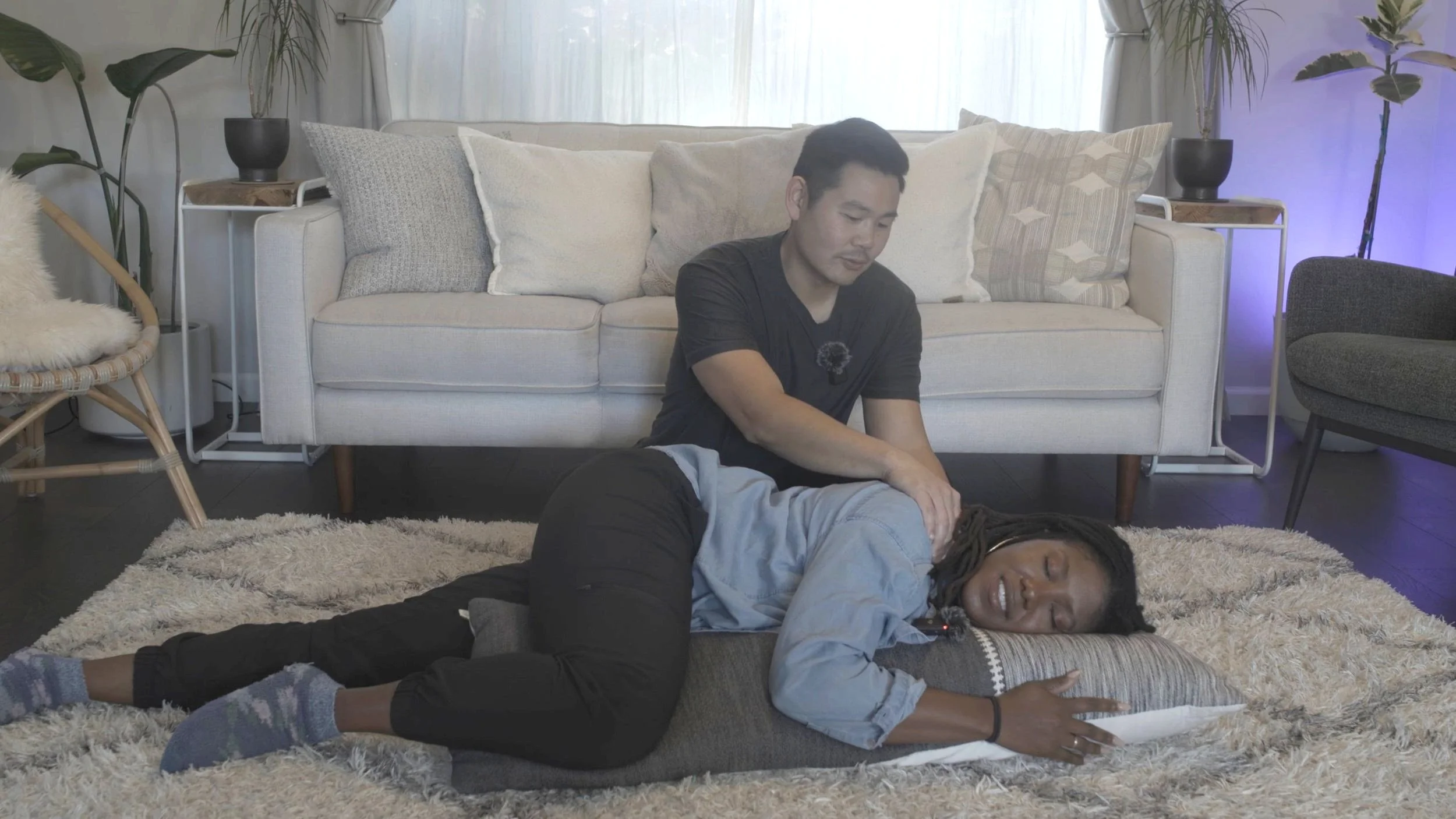
During labor, techniques such as breathing, movement, massage, visualization, music, and other relaxation strategies may help you cope with contractions.
But here's the important part:
Don't wait until labor to try them for the first time.
Practice now.
Notice where you hold tension.
Your jaw?
Your shoulders?
Your hands?
Practice releasing it.
Try different positions.
Learn what kind of touch helps you feel grounded.
Figure out what your partner can say—or perhaps should definitely not say—when you're trying to focus. 😄
You're building familiarity.
So when labor gets intense, you're not reaching for a completely new skill.
5. Prepare Your Partner Too
This might be the most overlooked piece of natural birth preparation.
You can prepare your body.
You can prepare your mindset.
You can practice every breathing technique you can find.
But when you're in the middle of labor?
Having someone beside you who knows what to do can change the whole experience.
And here's what most couples don't realize:
Your partner doesn't need to magically become a birth expert.
They need training.

During all four of my births, Stephen wasn't just physically present.
He had a role.
When contractions intensified, his calm helped ground me.
His voice was familiar.
Steady.
Safe.
I wasn't trying to remember everything by myself while also doing the work of labor.
We were a team.
And that's what I want for the couples we teach.
What Can a Prepared Partner Actually Do?
A prepared partner can learn how to:
guide breathing and relaxation
use massage and counterpressure
suggest helpful positions
protect the environment when you need to focus
remind you of what you've practiced
help communicate your preferences
ask questions when a decision comes up
stay calm enough to help you stay grounded
That's very different from:
“Just tell me what you need.”
Because there's a good chance that while you're deep in labor, you won't want to give a TED Talk about what kind of sacral pressure you need.
Your partner should already have some tools.
That's why we say:
Train your partner to be your Daddy Doula.
Not because they replace your doctor, nurse, midwife, or doula.
But because your partner knows you.
And when they're prepared too, you don't have to carry the entire mental load of birth alone.
What If Natural Birth Doesn't Go According to Plan?
This is where I want to challenge another idea about birth preparation.
Sometimes parents think:
Why prepare this much if I could end up needing an epidural anyway?
Or:
What if I prepare for an unmedicated birth and end up having a C-section? Won't all of this have been for nothing?
No.
Because good birth preparation isn't only preparation for one perfect outcome.
It's preparation for birth.
If your plans change, you can still use what you've learned.
You can still ask questions.
You can still understand what is happening.
Your partner can still support you.
You can still participate in decisions.
You can still use breathing, communication, coping, and advocacy skills.
Sometimes preparation helps you stay the course you hoped for.
Sometimes preparation helps you navigate the unexpected without feeling like the entire birth suddenly happened to you.
Both matter.
Your goal isn't to perform natural birth perfectly.
Your goal is to walk into birth with skills, support, and confidence.
The Truth Most Couples Learn Too Late
Here's where I think birth education often misses the mark.
Information alone doesn't prepare you for birth.
You can read 100 articles and still freeze when something happens that wasn't in the plan.
Because the real question isn't:
“How much do I know about birth?”
It's:
“Do we know what to do with what we know?”
Can you recognize what's happening?
Can you work with labor instead of immediately fighting it?
Can your partner help when contractions get intense?
Can you ask good questions if the plan changes?
Can you make a decision without feeling rushed or completely lost?
That's the kind of preparation that changes birth.
We Don't Just Teach Birth. We Train Teams.
This is one of the biggest differences in how we teach inside Our BirthRoom® Academy.
We aren't trying to turn you into an obstetric textbook.
And we're not trying to turn your partner into a medical professional.
We're helping the two of you become a prepared birth team.
You learn how labor works.
You build practical coping skills.
You learn how to prepare physically and mentally.
Your partner learns how to support you.
And you both learn how to navigate decisions when birth doesn't follow a perfect script.
Because you don't need to know everything that could happen.
You need a system for responding to what actually happens.
That's preparation.
Before Labor Starts, There Are 3 Things I Want You to Know
If you're a first-time parent, you probably don't need more random birth information.
You need to know what actually matters.
That's why Stephen and I created our free class:
The 3 Things Every First-Time Parent Should Know Before Labor Starts

Inside, we'll show you why information alone isn't enough, what helps you prepare for labor even when things don't go exactly as planned, and how your partner can become one of your greatest sources of support.
So when labor begins, you're not looking at each other thinking:
Now what?!
You're grounded.
You're prepared.
And you're ready to work together.
Because birth isn't just something you go through.
It's something you can prepare for.
And confidence changes everything.
Keep Preparing for Birth
If you’re serious about birth preparation, start here:
• How to Work With Contractions (Instead of Fighting Them)
• How to Prepare Your Partner for Birth (So They Actually Know What to Do)
• What to Expect in Early Labor
